

Signs of Quality Wire Wrapped Jewelry to Spot Before You Buy
Last Updated: November 1, 2026
Quick Summary
Quality wire wrapped jewelry is handmade jewelry in which a continuous length of jewelry wire is shaped, coiled, and tensioned around a gemstone so the stone stays secure without glue, and the difference between good and poor work shows in the wire, not the stone. Check wire consistency, wrap tightness, symmetry, and finish, and always inspect the back of the piece.
- Wire gauge works in reverse: lower gauge numbers mean thicker wire.
- Frame and structural wire commonly runs from about 16-gauge to 22-gauge.
- Weaving and binding wire typically runs from about 24-gauge to 28-gauge.
- A secure stone setting passes three tests: no shifting, multiple contact points, no sharp ends.
- A piece that fails two or more checklist lines deserves a return or a pass.
Table of Contents
- What Separates Quality Wire Wrapped Jewelry From the Rest
- How to Tell the Quality of Jewelry at a Glance
- Wire Gauge for Jewelry Making and What It Means for Durability
- The Best Wire for Wire Wrapping Gemstones and How It Ages
- How to Check a Stone Setting for Security and Stone Movement
- Red Flags in Product Photos and Online Listings
- A Practical Quality-Inspection Checklist for Buyers
- Shop Handmade Pieces You Can Inspect With Confidence
- Frequently Asked Questions
What Separates Quality Wire Wrapped Jewelry From the Rest
Quality wire wrapped jewelry is handmade jewelry in which a continuous length of jewelry wire is shaped, coiled, and tensioned around a gemstone or focal piece so the stone stays secure without glue, and the difference between good and poor work shows in the wire, not the stone.
The short version: a beautiful stone can sit inside sloppy wirework, and a modest stone can sit inside flawless wirework. The wire tells you which maker cared.
If you're weighing whether handmade pieces justify their cost at all, our guide on whether handmade jewelry is worth the price covers the broader value argument before you start judging individual pieces.
How to Tell the Quality of Jewelry at a Glance
You can tell the quality of jewelry at a glance by checking four things in order: wire consistency, wrap tightness, symmetry, and finish. Most buyers only look at the stone. Flip that habit and the piece will tell you almost everything within thirty seconds.
The Back of the Piece Tells the Real Story
Turn the pendant over. The back is where makers cut corners, because it's the side that gets photographed least. Look for wire ends that are tucked and smoothed rather than left as sharp stubs, coils that sit flat against the stone instead of floating above it, and a wrap pattern that stays even where nobody would notice.
Handmade Character vs. Poor Workmanship
Handmade character means small variations that follow the stone's shape: a coil that widens slightly where the gemstone bulges, a wrap that shifts to accommodate a natural dip. Poor workmanship means variation with no reason behind it: gaps that open and close at random, wire crossing over itself without purpose, one side noticeably tighter than the other.
Ask yourself whether each irregularity responds to the stone. If it does, it's character. If it doesn't, it's a shortcut.
Wire Gauge for Jewelry Making and What It Means for Durability
Wire gauge for jewelry making is the measurement of wire thickness, and it works in reverse: lower gauge numbers mean thicker wire.
The practical ranges are worth memorizing, because they tell you what a piece is built to do.
Gauge also interacts with metal.
Work hardening is the mechanism buyers rarely hear about.
Thin wire has its place. Fine gauges suit delicate weaving wire and decorative coils that sit on top of a heavier frame.
If you want to see what properly gauged construction looks like on a finished piece, our guide on what makes artisan jewelry durable walks through the construction details that matter.
The Best Wire for Wire Wrapping Gemstones and How It Ages
The best wire for wire wrapping gemstones is a metal that holds its shape, resists tarnish, and suits the wearer's skin: sterling silver and gold-filled wire are the two most common choices for everyday pieces, while bare copper is softer and darkens over time. Each behaves differently as it ages, and knowing which is which prevents disappointment later.
- Sterling silver: firm enough for frame wire, polishes back to bright with a cloth, and develops a soft patina in recessed areas.
- Gold-filled wire: a thick layer of gold bonded to a base metal, more durable than plating and slower to wear through.
- Copper wire: pliable and warm-toned, but it tarnishes quickly and can leave a green mark on skin.
Tarnish isn't a defect. It's chemistry, and it responds to care. Our guide to caring for natural gemstones covers how to keep both wire and stone looking their best.
How to Check a Stone Setting for Security and Stone Movement
A secure stone setting passes three tests: the stone doesn't shift when gently pressed, the wire contacts the stone at multiple points, and no sharp wire end sits where it can catch on clothing. Run these checks before the piece goes into regular rotation.
Rare Idaho Bruneau Jasper Heart Pendant | Gold Wire Wrapped Gemstone Jewelry →
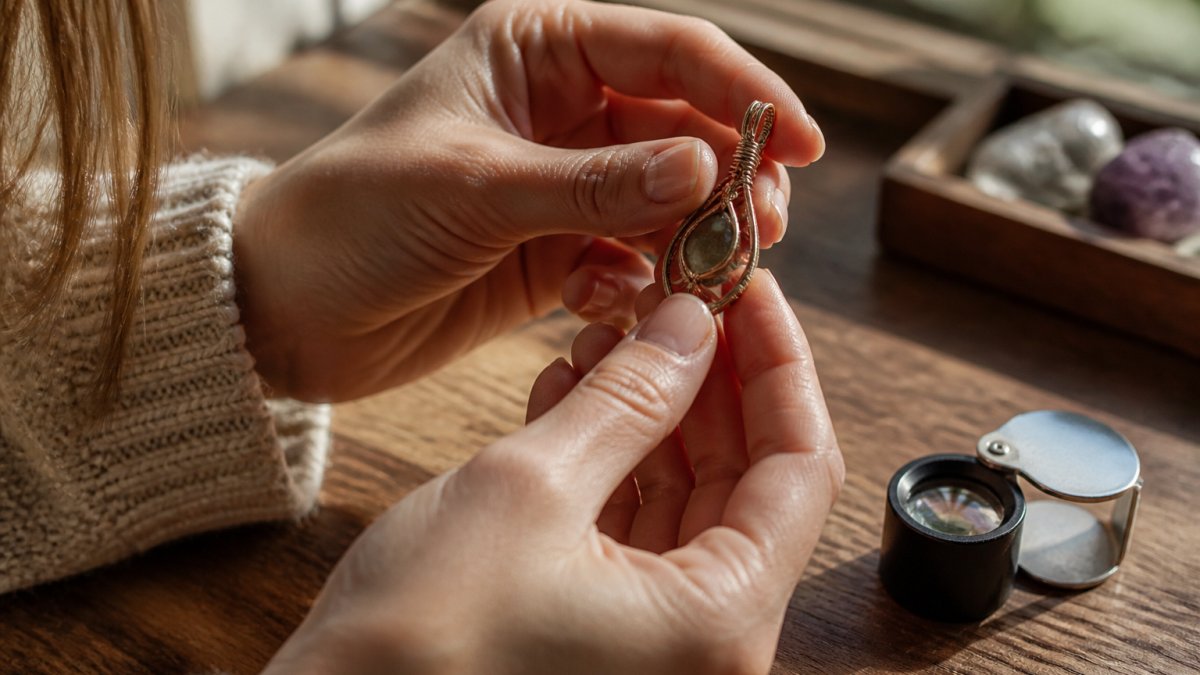
Work through the checks in order, from least to most forceful, and stop at the first failure. The goal is to find problems without causing them.
- Visual pass, front and back. Look at every place the wire meets the stone. Good wrapping grips the stone at several points around its edge, distributing pressure. A single loop over the top is decoration, not a setting. On the back, confirm the wire sits flat against the stone rather than bridging across a gap.
- The gentle press. Press the stone lightly with your thumb and watch for movement inside the wrap. A tiny amount of play in a decorative wrap is normal. A stone that rocks, clicks, or rotates is not. Do this over a soft surface, like a folded towel, in case a loose stone drops.
- The fingertip trace. Trace a fingertip around every wire end. Snagging means the end wasn't filed or tucked, and that same edge will catch on knitwear and hair. Run a piece of fine nylon stocking or a cotton swab along the wire; fibers that catch reveal a burr you can't feel.
- The light shake. Hold the piece a few inches above the towel and shake it gently side to side. A rattle or click means the stone is loose inside the wrap. Never shake a piece over a hard floor.
- The hang test. Hold the pendant by its bail and let it hang freely. The stone should sit balanced in the wrap, not pull the frame out of shape or hang noticeably to one side.
The failure modes to recognize are specific. A stone that rotates usually means the wrap contacts it at too few points, so the wire acts like a pivot rather than a cage. A click or rattle points to a gap between wire and stone that opened as the metal relaxed. A frame that flexes at the bail suggests the structural wire is too thin for the stone's weight. And wire that has crept away from the stone at one edge, leaving a visible gap, is the classic sign of under-tensioned wrapping that will worsen with wear.
Durability shows up in how the setting behaves over time, not just on day one. A well-tensioned wrap holds the stone through normal handling, dressing, and light bumping against a desk or doorframe.
Red Flags in Product Photos and Online Listings
Product photos hide more than they reveal, and the omissions are the tell. Watch for listings that show only the front of a pendant, never the back, never a side angle, and never a close-up of the wirework.
Other warnings:
- Blurry images at the exact spot where the wire meets the stone
- Descriptions that name the gemstone in detail but say nothing about the wire metal
- No mention of wire gauge, wire type, or setting method
Material disclosure matters as much as photo quality. If a listing won't tell you whether the wire is sterling silver, gold-filled, or plated, assume the least durable option until the maker confirms otherwise.
A Practical Quality-Inspection Checklist for Buyers
Use this checklist when a piece arrives, or when you're evaluating close-up photos before ordering. Score each line honestly; a piece that fails two or more deserves a return or a pass.
| # | Check | What Good Looks Like | Warning Sign |
|---|---|---|---|
| 1 | Wire consistency | Even thickness throughout the frame | Frame wire visibly thinner on one side |
| 2 | Wrap tightness | Coils sit flat against the stone | Gaps you can slide a fingernail under |
| 3 | Wire ends | Filed smooth and tucked out of sight | Sharp stubs or snagging edges |
| 4 | Symmetry | Balanced wrap pattern front and back | One side clearly tighter than the other |
| 5 | Stone security | No movement when gently pressed | Rocking, clicking, or rotation |
| 6 | Contact points | Wire grips the stone in several places | A single decorative loop holding the stone |
| 7 | Finish | Polished, no tool marks or scratches | Gouges, plier marks, dull patches |
| 8 | Material disclosure | Wire metal and gauge stated clearly | Wire type unlisted or vague |
With the checklist in hand, put it to work on a real piece: the Bruneau Jasper heart pendant is photographed closely enough to inspect the wrap, the wire ends, and how the gold wire follows the stone's natural pattern.

Shop Handmade Pieces You Can Inspect With Confidence
Our pieces are handcrafted by designer Joilene and are one of a kind. No two pendants share the same stone, so no two share the same wrap. That's the point of handmade work, and it's also why the inspection habits above matter: you're judging a specific piece, not a production line.
Our collection includes the Rainforest Jasper wire-wrapped pendant necklace, along with other gemstone pendants in gold and silver wire.

Frequently Asked Questions
What gauge wire is best for wrapping?
A frame wire needs enough thickness to hold a stone without bending, while finer binding wire should sit tight against it. When you shop, ask what gauge the frame uses; a maker who knows their materials will answer without hesitation.
How can you tell whether a gemstone is securely wire-wrapped?
Turn the piece over and press gently on the stone. A secure wire wrapped jewelry setting holds the stone with no rocking or rattle. Check that the frame wire crosses the stone's edges at several points, not just the top and bottom. Look for binding wraps pulled snug against the frame with no visible gaps. A stone that spins freely, sits loose in its cage, or shifts when you tilt the pendant is not set securely, no matter how neat the front looks.
What should the back of a well-made wire wrap look like?
The back should be nearly as tidy as the front, with wire tails tucked in or filed smooth and no sharp points that catch on clothing or skin. If a listing only shows the front of a pendant, ask for a photo of the back before you buy.
Which wire materials are best for durable wire-wrapped jewelry?
Ask the maker exactly what the wire is, and compare durability between metals rather than relying on color alone. Ask the maker exactly what the wire is, not just its color.
How thick is 22 gauge jewelry wire?
In the American Wire Gauge system, 22 gauge wire measures about 0.025 inches in diameter, roughly 0.64 millimeters. It is a middle-weight wire: sturdy enough for ear wires, small frames, and light structural wraps, but flexible enough to shape by hand. Many makers use 22 gauge for earring components and 20 gauge for larger pendant frames. Thicker numbers mean thinner wire, so 28 gauge is much finer than 22 gauge.
How do I know if wire-wrapped jewelry is good quality when shopping online?
Ask for close-up photos of the front, back, and stone edges, plus the wire material and gauge. Read the listing for specifics like sterling silver or gold-filled rather than vague terms. Check reviews for mentions of durability over months, not just arrival condition. A trustworthy maker will answer questions about construction, offer repairs, and show real detail shots. If the listing shows only styled photos with no close-ups, treat that as a reason to ask before ordering.
Buying handmade jewelry online asks you to trust a photograph, and that's a real leap. We'd rather give you the tools to verify the work than ask for blind faith. Browse the collection at Jasper Rain Designs, compare the wirework across pieces, and choose the one whose craftsmanship you can see for yourself.


