

How to Care for Natural Gemstones: A Complete Guide
Last Updated: October 23, 2026
Quick Summary
To care for natural gemstones, clean them with warm water and mild dish soap using a soft brush, then rinse and dry thoroughly with a soft cloth. Match each stone to its care tier: hard stones like diamonds tolerate standard cleaning, softer stones need gentler handling, porous stones require only a damp cloth, and organic gems like pearls need the gentlest approach of all.
- Store each gemstone piece separately in soft pouches to prevent stones from scratching each other.
- Never use ultrasonic cleaners, steam cleaners, or harsh chemicals on gemstone jewelry.
- Avoid sudden temperature changes and extreme heat, including hot tubs, saunas, and prolonged direct sunlight.
- If a stone is loose or jewelry is damaged, seek professional repair rather than attempting fixes yourself.
- Confirm treatment status before cleaning; when unsure, hand-clean only with lukewarm water and mild soap.
Table of Contents
- Why Proper Gemstone Care Matters
- How to Clean Gemstone Jewelry at Home
- Gemstone-Specific Care Requirements
- Understanding Gemstone Treatments and Care
- How to Store Gemstone Jewelry Properly
- Wire-Wrapped Jewelry Care and Maintenance
- What to Avoid When Caring for Natural Gemstones
- When to Seek Professional Care
- Frequently Asked Questions
Why Proper Gemstone Care Matters
Natural gemstones are delicate, and knowing how to care for natural gemstones keeps them beautiful.
At Jasper Rain Designs, we create handcrafted jewelry with natural gemstones meant to become heirlooms, but they require knowledge to maintain.
A single mistake, the wrong cleaner, extreme heat, careless storage, can permanently damage your investment.
This guide covers safe cleaning methods, stone-specific requirements, storage, and when to call a professional.
How to Clean Gemstone Jewelry at Home
Most gemstone jewelry responds well to a three-step method: prepare a mild solution, soak and gently scrub, then rinse and dry.

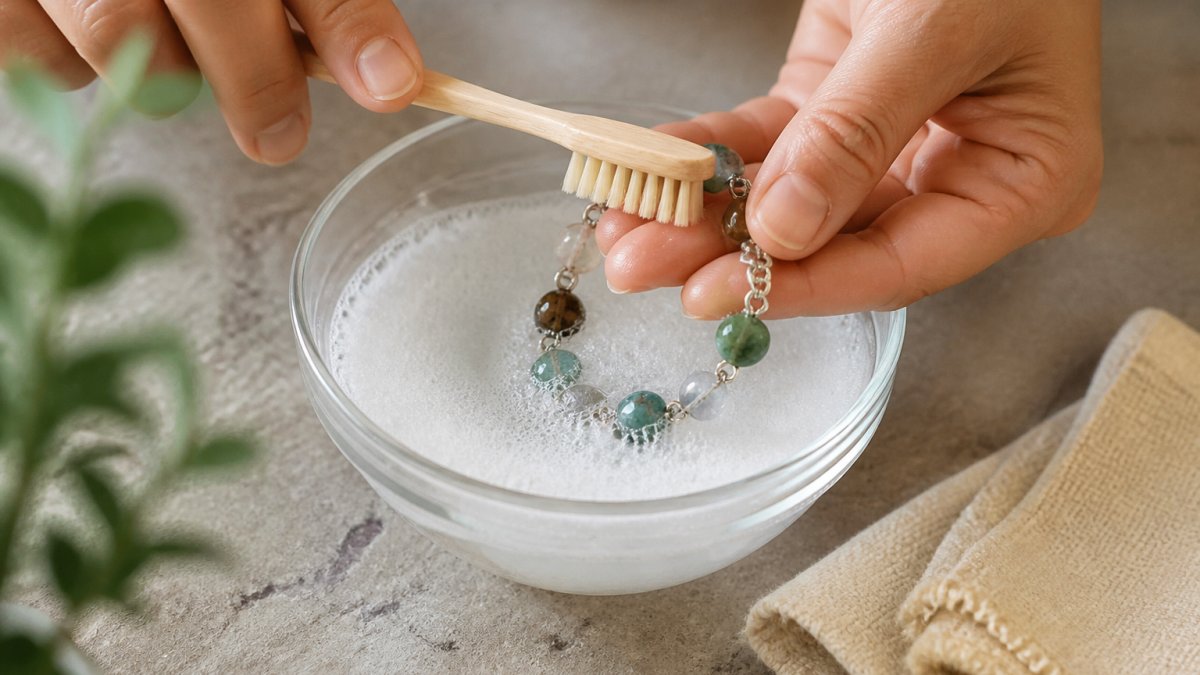
Step 1: Prepare Your Cleaning Solution
Fill a small bowl with lukewarm water and add a few drops of mild dish soap.
You don't need special jewelry cleaners; mild soap and water work just as well. Avoid harsh or abrasive cleaners, which can scratch delicate gemstones or damage their polish.
Step 2: Soak and Gently Scrub
Soak your jewelry in the warm soapy water for a few minutes to loosen dirt and debris.
Use a soft toothbrush or cloth to gently scrub the stone and setting, paying attention to crevices.
For wire-wrapped jewelry, brush gently around the wrapped areas so water doesn't get trapped.
Step 3: Rinse and Dry Thoroughly
Rinse until all soap residue is gone, then dry immediately with a soft cloth. Don't air-dry: water spots can form and standing water can seep into settings.
Pat dry gently, since rubbing can scratch softer gemstones.
Gemstone-Specific Care Requirements
Some gemstones are fragile, others nearly indestructible. Before cleaning any piece, identify the stone and match it to a care tier using the chart below.
Stone-by-Stone Care Chart
| Gemstone | Mohs Hardness | Water & Mild Soap | Ultrasonic | Heat / Steam | Key Risk |
|---|---|---|---|---|---|
| Diamond | 10 | Yes | Usually safe (check settings) | Generally tolerant | Chips on impact; grease dulls surface |
| Ruby | 9 | Yes | Usually safe (unfilled only) | Generally tolerant | Fracture-filled stones react to heat |
| Sapphire | 9 | Yes | Usually safe (unfilled only) | Generally tolerant | Diffusion and fracture-fill treatments |
| Emerald | 7.5-8 | Brief only | No | No | Usually oiled or resin-filled; soaking and heat draw out filler |
| Aquamarine | 7.5-8 | Yes | Usually safe | Generally tolerant | Heat can alter color in some stones |
| Morganite | 7.5-8 | Yes | Usually safe | Generally tolerant | Can be irradiated; sudden heat risky |
| Quartz (clear, smoky, rose) | 7 | Yes | Usually safe | Generally tolerant | Rose quartz fades in prolonged sunlight |
| Amethyst | 7 | Yes | Usually safe | Avoid sudden heat | Color can fade with heat and long sun exposure |
| Citrine | 7 | Yes | Usually safe | Avoid sudden heat | Heat-treated amethyst; color stable but brittle |
| Tourmaline | 7-7.5 | Yes | Usually safe | Avoid sudden heat | Can be fracture-filled; thermal shock risk |
| Garnet | 6.5-7.5 | Yes | Usually safe | Avoid sudden heat | Some varieties are brittle |
| Peridot | 6.5-7 | Yes | Usually safe | Avoid | Sensitive to thermal shock and acids |
| Jade (nephrite, jadeite) | 6-7 | Yes | Usually safe | Generally tolerant | Dyes and polymer treatments on some pieces |
| Opal | 5.5-6.5 | No soaking | No | No | Porous; water and heat cause crazing |
| Turquoise | 5-6 | No soaking | No | No | Porous; often stabilized or dyed |
| Lapis lazuli | 5-6 | Brief only | No | No | Porous; dyes and coatings common |
| Moonstone | 6-6.5 | Brief only | No | No | Cleavage planes; heat and chemicals risky |
| Pearl | 2.5-4.5 | Damp cloth only | No | No | Nacre dissolves in acids and harsh soap |
| Coral | 3-4 | Damp cloth only | No | No | Porous; dyes and bleach damage |
| Amber | 2-2.5 | Damp cloth only | No | No | Softens with heat; solvents dissolve surface |
| Malachite | 3.5-4 | No soaking | No | No | Porous; reacts with acids and heat |
| Rhodochrosite | 3.5-4 | Brief only | No | No | Soft and brittle; scratches easily |
Use the chart as a starting point: two stones of the same species can behave differently if one is treated and the other is not.
Hard Stones: Diamonds, Sapphires, and Rubies
These three rank at the top of the Mohs hardness scale, resisting scratches from normal wear. Clean them with the warm water and mild soap method above, and wear them daily without worry.
Sapphires and rubies come in many colors and all clean the same way, with one caveat: a fracture-filled ruby or sapphire should not go in an ultrasonic cleaner or near steam, because heat and vibration affect the filler.
Quartz-Family Stones: Amethyst, Jasper, Agate, and Citrine
These softer gemstones need gentler handling. Amethyst, jasper, agate, and citrine are all quartz-based stones with unique patterns and colors.
Clean them with the same warm water and mild soap method, but use a soft cloth rather than a toothbrush and avoid scrubbing hard.
If you own a Jasper Gemstone Bracelet or Frosted Jasper Gemstone Bracelet from our collection, treat it with this gentle approach.

Water-Sensitive and Porous Stones
Some gemstones should never be soaked: opal, turquoise, lapis lazuli, malachite, and other delicate stones. Water can seep in and cause cracking, crazing, or lost luster.
For water-sensitive stones, skip the soak: dampen a soft cloth with soapy water, gently wipe the stone, wipe again with a clean damp cloth to remove residue, and dry immediately.
When in doubt, ask: is this stone porous or fragile? If yes, use the damp-cloth method instead of soaking.
Organic Gemstones: Pearls, Coral, Amber
Pearls, coral, and amber are organic and need a different approach. Pearls are coated in nacre, which dissolves in acids and harsh soap. Coral is porous and often dyed.
For all three, use a damp soft cloth only, never soak, ultrasonic clean, or steam. Store pearls away from direct heat and avoid spraying perfume directly on them.
Loose Gemstones Versus Mounted Jewelry
A loose stone can be cleaned more thoroughly, but it's easier to drop or scratch. Work over a soft towel so a dropped stone doesn't chip.
Mounted jewelry adds the setting: dirt collects under prongs and water can pool there. Clean the underside of the setting, dry with a soft cloth or compressed air held at a distance, and check prongs after every few cleanings, a loose prong is the most common cause of a lost stone.
Understanding Gemstone Treatments and Care
Many natural gemstones are treated to enhance color or clarity, which changes what cleaning methods are safe. Treatment status is often invisible, so first learn what you own.
Common Treatments and What They Mean for Care
Heat treatment is the most common; sapphires, rubies, tanzanite, and many other stones are heated to improve color.
Fracture filling is different.
Gemstone bracelet, adjustable →
Diffusion uses heat and chemicals to push color into a stone's surface, most often sapphire.
Irradiation changes color in topaz, tourmaline, and other stones.
Dyeing and stabilization are common on porous stones such as turquoise, lapis lazuli, and coral.
How to Identify Treatments Before You Clean
Start with the paperwork. A reputable seller should disclose known treatments on the receipt, appraisal, or gemological report.
If you inherited jewelry or bought it secondhand, look for a gemological report from a recognized laboratory, which lists treatments when detectable.
A few field clues help: filled emeralds sometimes show a flash or trapped-bubble pattern under magnification, dyed turquoise can show dye concentrated in cracks, and coated stones may have an uneven sheen.
A Simple Decision Rule
If you can't confirm a stone's treatment status, clean it as if it is treated: hand-clean with lukewarm water and mild soap, no soaking beyond a minute or two, no ultrasonic, no steam, no harsh chemicals. This won't damage an untreated stone and protects a treated one.
Physical Cleaning Versus Crystal Cleansing
Physical cleaning removes dirt, oils, and residue with water, soap, and a soft cloth. Crystal cleansing, moonlight, salt, sound, or intention, is a separate practice and no substitute. Salt is abrasive and can scratch softer stones, and saltwater is corrosive to metal settings. Keep any cleansing practice separate from the routine here, and avoid salt and water immersion for porous or treated stones.
How to Store Gemstone Jewelry Properly
Keep jewelry in a cool, dry place away from direct sunlight, which can fade some colored gemstones.
Store wire-wrapped pieces flat or hang them carefully, don't toss them in a drawer where they might get tangled or bent.
If you own a Pink Agate Gemstone Bracelet or other elastic-cord bracelets, store them loosely; constant tension weakens the elastic cord over time.

Keep jewelry away from perfume, lotion, and hairspray, which build up on gemstones and dull their shine.
Wire-Wrapped Jewelry Care and Maintenance
Wire-wrapped jewelry from Jasper Rain Designs combines natural gemstones with carefully wrapped wire, which requires specific care.
The wire is usually copper or another metal and can tarnish over time with exposure to air and moisture.
If tarnishing occurs, gently polish the wire with a soft cloth.
The wire wrapping is durable, but don't pull or bend it. Treat wire-wrapped jewelry gently during wear and storage.
What to Avoid When Caring for Natural Gemstones
Don't use steam cleaners.
Avoid harsh chemicals. Bleach, acetone, and strong solvents can damage gemstones and metal settings.
Don't expose gemstones to extreme heat or sudden temperature changes, including hot tubs, saunas, and extended direct sunlight.
Never use abrasive scrubbers or rough cloths. These scratch gemstones, especially softer ones like amethyst or jasper.
Keep jewelry away from beach sand, chlorine, and saltwater, which damage gemstones and settings over time.
| What to Avoid | Why | Alternative |
|---|---|---|
| Ultrasonic cleaners | Can damage stones and loosen settings | Warm water and soft brush |
| Steam cleaners | Water can get trapped in settings | Gentle hand cleaning |
| Harsh chemicals | Damage stones and metal | Mild dish soap |
| Extreme heat | Can crack or discolor stones | Store in cool, dry place |
| Abrasive scrubbers | Scratch delicate gemstones | Soft cloth or soft brush |
| Rough handling | Loosens stones and bends wire | Gentle care during wear and storage |
When to Seek Professional Care
If your jewelry is damaged, a cracked stone, a bent wire, a broken clasp, take it to a jeweler.
For wire-wrapped jewelry from Jasper Rain Designs that needs repair, reach out to us.
Professional cleaning is also an option.
Caring for natural gemstones doesn't require special skills or expensive products.
Your gemstone jewelry from Jasper Rain Designs is handcrafted to last.
Frequently Asked Questions
How do you clean natural gemstones safely?
The safest method is to soak your gemstone jewelry in lukewarm water with mild dish soap for 15-20 minutes, then gently scrub with a soft toothbrush or soft cloth. Rinse thoroughly under running water and dry with a lint-free cloth. Avoid harsh chemicals, abrasive cleaners, ultrasonic cleaners, and steam cleaners, as these can damage delicate stones or remove protective treatments applied during cutting.
Which gemstones should not be soaked in water?
Water-sensitive stones like opals, emeralds, and turquoise can absorb water and swell, causing cracks or damage. Porous stones may also trap moisture internally. For these gemstones, use a damp (not wet) soft cloth to gently wipe the surface instead of soaking. Always check whether your specific stone has been treated, as some treatments make stones even more sensitive to water exposure.
How should you store gemstone jewelry?
Store each piece separately in a soft cloth pouch or lined jewelry box to prevent scratching and tangling. Keep gemstone jewelry away from direct sunlight, heat sources, and sudden temperature changes, which can cause discoloration or cracking. Store in a cool, dry place away from moisture. For valuable or delicate pieces, consider a climate-controlled storage area. Prevent chemical exposure by storing away from perfumes, lotions, and cleaning products.
How do you care for wire-wrapped gemstone jewelry?
Wire-wrapped pieces require extra care at the wire joints where stones are held. Avoid bending or twisting the wire, and be gentle when cleaning around the wrapped areas. Use a soft cloth rather than a brush near the wrapping. When storing, support the piece so the stone doesn't put pressure on the wire. If you notice loose wrapping or a shifting stone, have it repaired by a professional jeweler before wearing it again.


