

Artisan Jewelry Repair and Maintenance: The Complete Guide
Last Updated: November 26, 2026
Quick Summary
Artisan jewelry repair starts with inspecting contact points such as stone settings, clasps and wire joins, since handmade construction varies from piece to piece. Simple fixes like tightening a loose clasp or cleaning with mild soapy water can be done at home. Stone replacement, soldering and chain rebuilding belong with a professional who can provide a written estimate first.
- Inspect wire-wrapped pieces monthly for gaps, flattened wraps and loose stones.
- Clean most solid-metal, untreated-stone pieces in lukewarm water with mild dish soap for no more than a minute.
- Avoid ultrasonic cleaners and steam on artisan pieces unless a jeweler confirms the stone and setting are safe.
- Photograph the piece and get a written estimate and target completion date before handing it over.
- Repair usually makes sense for heirloom pieces when the metal and stones are sound and the cost is modest.
Table of Contents
- Why Artisan Jewelry Needs Different Care
- Wire-Wrapped Jewelry Care: Inspection and Storage Routine
- How to Clean Gemstone Jewelry Safely at Home
- Jewelry Repair Tools for Beginners: What to Keep on Hand
- Common Jewelry Repairs and What Causes Them
- Professional Repair Costs, Turnaround and Documentation
- Booking Your Next Repair or Custom Redesign
- Frequently Asked Questions
Why Artisan Jewelry Needs Different Care
Artisan jewelry repair starts with understanding what makes handmade pieces different from mass-produced ones. Hand-set stones, hand-formed wire and one-off soldered joins behave differently under daily wear, so they need a different routine.
Handmade jewelry is defined as pieces where the maker shapes, sets and finishes each element by hand rather than through casting or stamping in volume. That distinction matters for care.
Most owners of handmade jewelry find that the earliest problems show up at contact points: where a stone is held, where a clasp closes, and where wire crosses wire.
Wire-Wrapped Pieces and Hand-Set Stones
Wire-wrapped pendants hold stones through a lattice of wire rather than a metal setting. The wire is the structure, so its tension and the number of wraps determine how securely the stone sits. Hand-set stones may be held by prongs or bezels that were pressed by hand, which means the grip can loosen gradually with wear.
A common mistake is assuming a wrapped stone is permanently secure because it looks solid. Wire can fatigue at bends, especially where a pendant swings against a chain. Inspect those bends first.
Wire-Wrapped Jewelry Care: Inspection and Storage Routine
Wire-wrapped jewelry responds well to a short, regular inspection. Once a month, hold the piece under good light and check each wrap for gaps, flattened sections or wire that has started to work loose. Gently press the stone to see whether it moves in its setting.
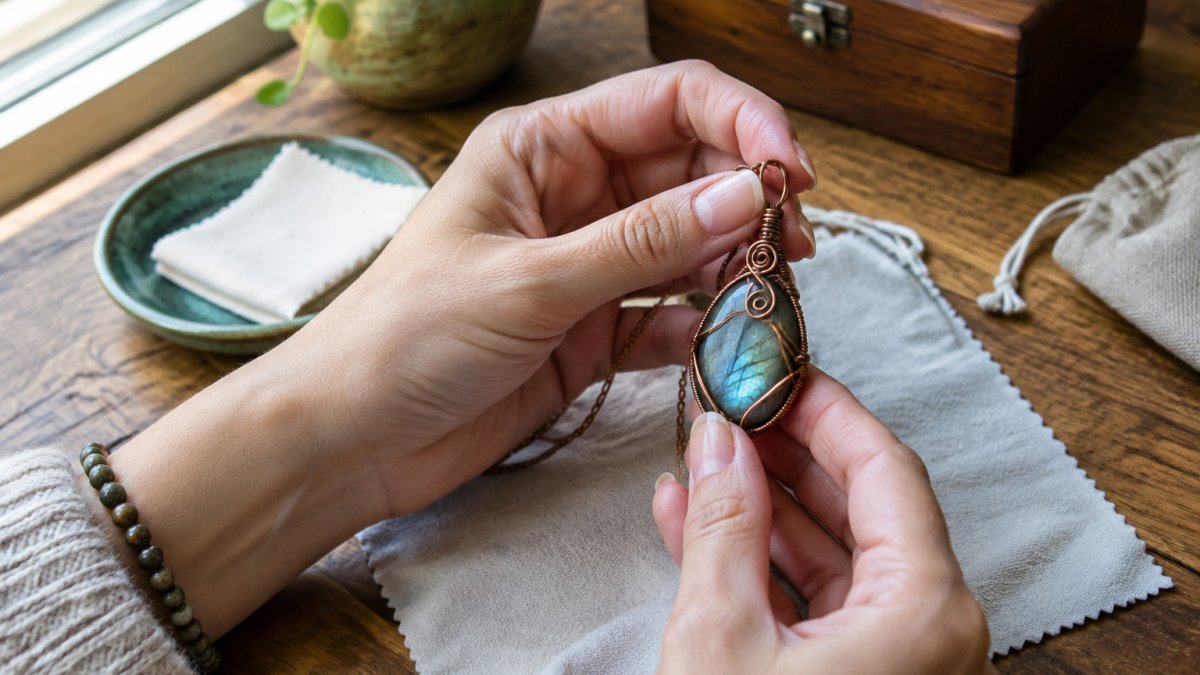
Storage matters as much as inspection. Store wire-wrapped pieces separately so that wire does not catch on chains or other pendants. Hanging them or keeping them in a padded compartment prevents the kind of kinking that weakens thin wire over time.
How to Clean Gemstone Jewelry Safely at Home
Safe home cleaning starts with knowing your stone and your metal, because a method that suits one combination can damage another. Before using any cleaner, confirm the stone's hardness on the Mohs scale, whether it has been treated (heat, fracture-fill, dye, coating), and whether the piece contains glued components, plated metal, or pearls and beads. When in doubt, clean less aggressively and let a professional handle it.
Material-by-Material Cleaning Guidance
Gold (yellow, white, rose). Solid gold tolerates lukewarm water, mild dish soap, and a soft brush.
Sterling silver. Silver tarnishes from sulfur in the air and on skin.
Platinum. Platinum is dense and resistant to corrosion but scratches and develops a matte patina.
Gold-plated and gold-filled metals. Plated pieces have a thin gold layer over a base metal; gold-filled pieces have a thicker, mechanically bonded layer.
Pearls and beads. Pearls are soft, porous, and sensitive to acids, heat, and chemicals.
Common gemstones. Diamond, sapphire, ruby, and quartz-family stones are hard and tolerate soapy water and a soft brush.
A Safe Default Routine
For most solid-metal, untreated-stone pieces:
- Mix a few drops of mild dish soap into lukewarm water.
- Soak the piece for no more than a minute, keeping wrapped, glued, or porous areas out of the liquid.
- Brush gently with a soft-bristled brush, focusing on the setting and the back of the piece rather than scrubbing the stone face.
- Rinse with clean lukewarm water and pat dry with a lint-free cloth.
- Let the piece air-dry fully before storing it.
Avoid ultrasonic cleaners, steam, and harsh chemical dips for artisan pieces unless a jeweler has confirmed the specific stone and setting are safe. Those methods can loosen settings, fracture treated or included stones, and dissolve adhesives used in mixed-material work.
Watch out: A stone that looks clean can still be loose. After any cleaning, press gently against the stone to check for movement before wearing the piece again.
Jewelry Repair Tools for Beginners: What to Keep on Hand
A small, well-chosen kit covers most home maintenance. Useful basics include a jeweler's loupe for checking prongs and wire joins, a set of fine-tipped tweezers, a soft-bristled brush, lint-free polishing cloths and a small bowl for mild cleaning. A bench block and a rawhide mallet let you gently close or reshape a bezel without marking the metal.
Leave soldering torches, stone-setting tools and anything that heats metal to a trained professional. Home tools are for inspection, cleaning and minor adjustments only.
Common Jewelry Repairs and What Causes Them
Most repairs on handmade jewelry trace back to a few causes: repeated friction at clasps, wire fatigue at bends, worn prongs or bezels, and chains stressed by pulling. Knowing the cause helps you prevent the next repair as well as fix the current one.
Simple Fixes You Can Attempt at Home
A loose clasp can often be tightened by gently closing the jump ring with two pairs of flat-nosed pliers. A slightly bent earring post can be straightened carefully on a bench block. Surface scratches on polished metal can be reduced with a fine polishing cloth. If the fix requires heat, cutting metal or moving a stone, it is no longer a home repair.
Repairs That Belong with a Professional
Stone replacement, prong retipping, soldering, chain rebuilding and any repair involving fine metal should go to a professional. A jeweler can assess whether a stone is secure enough to keep wearing and can match metal and finish so the repair does not show.
The table below summarises the typical causes of repairs and the fixes the article describes.
| Problem | Cause | Fix |
|---|---|---|
| Loose clasp | Repeated friction at the clasp | Tighten the jump ring with two pairs of flat-nosed pliers |
| Bent earring post | Stress or pressure on the post | Straighten carefully on a bench block |
| Surface scratches | Wear on polished metal | Reduce with a fine polishing cloth |
| Loose stone or failing prongs | Worn prongs or bezels | Take to a professional for stone replacement or retipping |
| Broken chain | Chain stressed by pulling | Professional chain rebuild |
Professional Repair Costs, Turnaround and Documentation
Professional repairs vary widely by the type of work, the metal, the stone, and the time involved, so treat any figure as a rough guide and request a written estimate before work begins. A reputable jeweler should explain what needs doing, why, and how long it will take, and should put that in writing.
Typical Cost Ranges and What Drives Them
Professional repair prices vary by region, metal, and stone; request a written estimate from your jeweler for an accurate figure. You can see what the custom jewelry repair service covers and how to request it.
Factors that push an estimate up include platinum and white-gold rhodium work, invisible or channel settings, treated or fragile stones that need special handling, hand-fabricated replacement parts, and any piece where the artisan must match an existing finish or patina.
Turnaround Expectations
Ask for a target date in writing and confirm whether the shop sends work out to a specialist (common for engraving, laser welding, or pearl stringing), since that adds transit time.
Repair Versus Replacement
Repair usually wins when the piece has sentimental or heirloom value, when the metal and stones are sound, and when the repair cost is a modest fraction of replacement. Replacement may make more sense when the base metal is failing, when plating has worn through across most of the piece, when a stone is chipped beyond safe re-setting, or when the repair estimate approaches the cost of a comparable new piece. For artisan work, replacement is rarely equivalent, because the original maker's hand and construction are not reproducible from a catalog.
Intake, Documentation, and Insurance Checklist
Before handing over a piece:
- Photograph the piece from multiple angles, including close-ups of the setting, clasp, and any existing damage.
- Write down the metal, stone types, approximate weights or dimensions, and any known treatments.
- Note the requested work and any constraints (do not re-polish, preserve patina, keep original stones).
- Get a written estimate and target completion date, and confirm whether the estimate is binding or a range.
- Ask how the piece is stored and insured while in the shop's possession, and whether the shop carries jewelers' block insurance.
- Keep the receipt, estimate, and before-photos together with any appraisal.
For higher-value pieces, a current appraisal supports both insurance scheduling and any claim.
For custom work, Jasper Rain Designs offers a custom jewelry repair service for pieces that need redesigning or recrafting.
For guidance on judging whether a maker is reputable before you commit, see how to find reputable jewelry artisans.
Watch out: Verbal estimates and handshake agreements leave you with little recourse if the finished work differs from what you expected. Get the scope, price, and timeline in writing before the piece leaves your hands.
Booking Your Next Repair or Custom Redesign
If a piece is broken, or you want an heirloom reworked into something new, the next step is simple. Describe the piece, note any stones or metals involved, and send your request through the custom order request form. For a deeper look at caring for stones once a repair is complete, read how to care for natural gemstones.

Shop our handmade pieces at Jasper Rain Designs and wear something made to last.
Frequently Asked Questions
How much does jewelry repair usually cost?
Costs vary by repair type and metal. Simple jobs such as a basic clasp replacement or a ring resize often fall in the lower range, while stone replacement, chain rebuilds and custom redesigns cost more. Ask for a written estimate before work begins, and compare it against the value of the piece and any sentimental importance. For custom repair and redesign requests, Jasper Rain Designs lists a $3.00 initial charge that is taken off the total cost, and a full refund is offered if the order cannot be fulfilled.
How do you clean handmade gemstone jewelry safely?
Start with a soft brush, lukewarm water and a drop of mild dish soap, then rinse and dry with a lint-free cloth. Avoid harsh chemicals, ultrasonic cleaners and steam on porous or softer stones, since these can damage them or loosen settings. Wire-wrapped pieces should be dried thoroughly so moisture does not stay trapped in the wraps. Check each stone after cleaning for looseness before you wear the piece again.
How often should you inspect wire-wrapped jewelry?
Look over wire-wrapped pieces every few weeks if you wear them often, and after any impact or long day of activity. Check for loose or kinked wire, thinning wraps, stones that rotate or wobble, and fraying at the bail or clasp. Catching a loose wrap early usually means a quick fix instead of a lost stone.
Can you repair a loose wire-wrapped gemstone at home?
Minor tightening can sometimes be done at home with smooth-jaw pliers, but only if the wire is still strong and you can see exactly how the wrap is held. Cutting, rewrapping or replacing wire is harder to do well and is easy to get wrong. If the stone moves freely, the wire is thin or broken, or the wrap has lost its shape, take it to a professional instead of risking the stone.
When should you take jewelry to a professional for repair?
Take jewelry to a professional when a stone is loose or missing, a prong is worn or broken, a chain or clasp has failed, or a metal part needs soldering or resizing. Professional repair is also the right choice for heirloom pieces and anything you want to keep long term. Ask for a written estimate, timeline and description of the work before you agree.
What tools are useful for basic jewelry repairs?
For beginners, a small set of smooth-jaw and chain-nose pliers, wire cutters, a bench block with a rawhide or nylon mallet, a fine file, a bead reamer and a bright work light covers most light tasks. Add a magnifier or loupe so you can see small wraps and prong edges clearly. Start with tools that handle wire and clasps, and leave soldering and stone setting to a trained jeweler.


