

How to Assess Handmade Jewelry Durability at Home
Quick Summary
Handmade jewelry durability depends on the metal and materials, the quality of solder joints and settings, and how you wear and store the piece. You can check these at home with good light, a careful hand, and simple gentle tests.
- Look for a 925, Sterling, or karat stamp to confirm the metal type.
- Inspect solder joints under bright light and press them gently for any movement.
- Test stone settings by lightly tapping the stone to check for shifting or rattling.
- Open and close clasps several times; they should snap shut firmly without sliding open.
- Home checks cannot measure solder strength or plating thickness, so treat them as screening only.
Table of Contents
- What Durability Really Means for Handmade Jewelry
- Step 1: Check the Metal and Material Quality
- Step 2: Inspect Solder Joints and Overall Construction
- Step 3: Test Stone Settings, Prongs and Wire Wraps
- Step 4: Examine Clasps, Closures and Connection Points
- Step 5: Run Simple At-Home Stress and Tarnish Tests
- Checking Your Piece Against Your Everyday Wear
- Your Next Step: Choosing a Piece That Will Last
- Frequently Asked Questions
What Durability Really Means for Handmade Jewelry
Last Updated: November 5, 2026
Handmade jewelry is beautiful, but how do you judge handmade jewelry durability before you buy? Handmade pieces are built by hand, and it helps to know what to look for before you buy. Durability means a piece holds its shape, keeps its stones secure, and resists tarnish through everyday wear. It does not mean a piece will never need care.
Handmade jewelry durability depends on three things: the materials, the construction, and how you wear and store it. For the fuller picture, see what makes artisan jewelry durable. A solid metal necklace with poorly soldered links can fail faster than a simpler piece built well. The reverse is also true.
We'll walk through five steps you can do at home with nothing more than good light and a careful hand. These checks will not replace a jeweler's inspection, but they will help you spot obvious weak points.
Step 1: Check the Metal and Material Quality
Start with the metal. Look for a stamp that reads 925 or Sterling, which marks sterling silver. If you are unsure whether a piece was made by hand, learn how to identify handmade jewelry.
Telling solid metal from plated or coated pieces
Plated jewelry has a thin layer of metal over a base metal, and that layer can wear through over time.
- Check the edges and clasp for a different color underneath
- Look for a stamp that reads 925, Sterling, or a karat mark
- Notice whether the color looks uniform across the whole piece
- Test a hidden spot for a dull or dark mark after rubbing with a white cloth
Here is a quick reference for the material checks covered in this step.
| Check | What to look for | Why it matters |
|---|---|---|
| Metal stamp | 925, Sterling, or a karat mark | Confirms the metal type |
| Edges and clasp | A different color underneath | Signals plating |
| Color uniformity | Even color across the piece | Uneven color can indicate plating |
| Hidden spot rub | Dull or dark mark on a white cloth | Points to a base metal |
Step 2: Inspect Solder Joints and Overall Construction
Good construction is one of the clearest signs of durability. Hold any piece close under a bright light and look at every join.
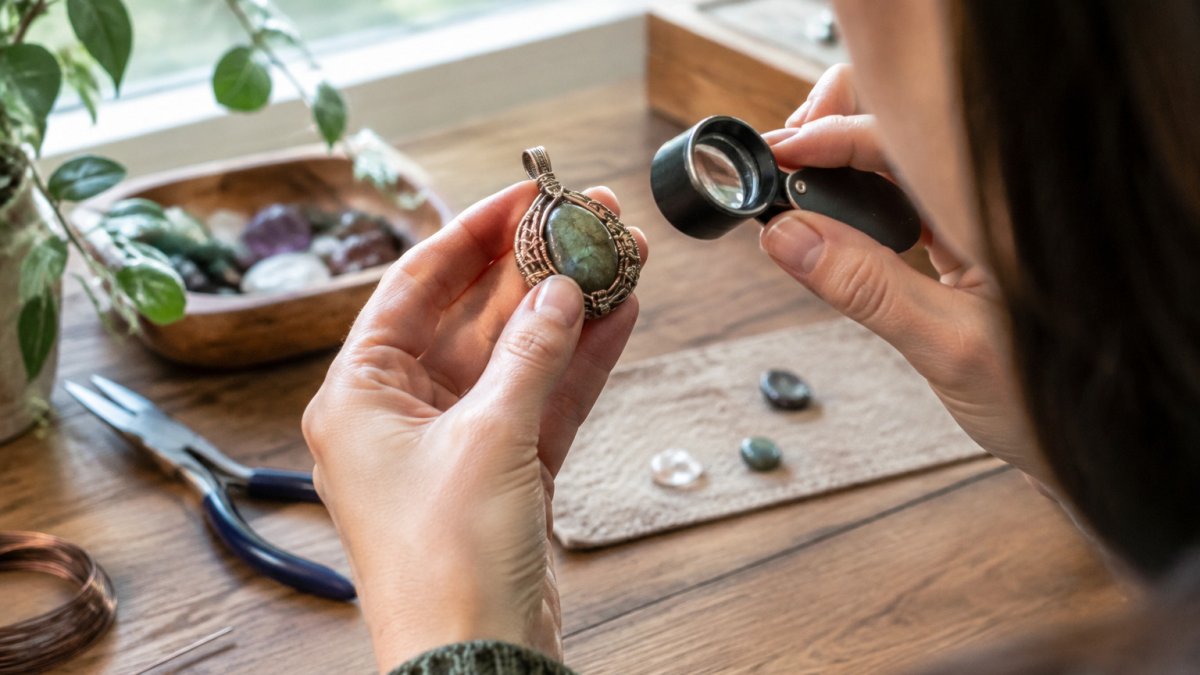
A well-soldered joint looks smooth and blends into the metal. A weak joint may show a gap, a dark line, or a bump of extra solder. Gently press the joints with your fingertips. Any movement or give means the join needs attention.
Also check the wire wraps on pendants. Wraps should sit snug and evenly spaced, with no loose ends poking out.
Step 3: Test Stone Settings, Prongs and Wire Wraps
Stones are often the first part to fail. Check how each stone sits in its setting.
- Make sure prongs or bezels fully hold the stone
- Look for prongs that are bent, thin, or uneven
- Check that the stone sits level and does not wobble
- Confirm that wire wraps grip the stone without cracking it
Set the piece on a soft towel and lightly tap the stone with a fingernail. A loose setting will shift or rattle.
Step 4: Examine Clasps, Closures and Connection Points
Clasps take the most daily stress. Open and close the clasp several times. It should snap shut firmly and hold without sliding open.
Pay close attention to jump rings and connectors. Each ring should close completely with no visible gap. Gently pull the chain at the connection points. A strong piece will not stretch or pull apart.
Step 5: Run Simple At-Home Stress and Tarnish Tests
These checks are designed to be safe and repeatable. They will not damage a well-made piece, and they help you spot weak points before they become failures. Always work over a soft towel and use gentle pressure, never force anything.
Custom jewelry repair service →
Safe stress checks by jewelry type
Different constructions fail in different ways, so match the test to the piece.
- Chains and necklaces: Hold the chain at both ends and let it hang. Look for kinks or stretched links. Gently run the chain through your fingers to feel for rough solder joints or open links. Do not pull hard, a light tug is enough to reveal a gap.
- Bracelets: Open and close the clasp ten times. It should snap firmly each time. Check that the hinge or lobster claw returns to its closed position without sticking. Gently flex the bracelet in a circle to feel for stiff links.
- Rings: Hold the ring by the band and press lightly on the stone with your thumb. A secure setting will not move. Check the band for thin spots near the sizing seam. Do not bend the band.
- Earrings: Hold the ear wire or post and gently wiggle the decorative element. It should not rotate or wobble. For lever-backs, open and close the lever several times to check tension.
- Wire-wrapped pieces: Gently press the wire wrap with your fingertip. The wraps should not shift or spread. Look for any wire end that lifts away from the bundle.
- Beaded designs: Hold the piece at both ends and let it hang. Gently roll the beads between your fingers to check for looseness. Do not pull the stringing wire.
Tarnish and plating checks
Tarnish is a surface reaction, not a structural failure, but it can signal base-metal content. A white cloth rubbed on a hidden area should not show dark residue on solid precious metal. If it does, the piece is likely plated or made from a base metal.
Watch out: A strong pull test can bend a prong or stretch a jump ring, turning a minor issue into a repair. If a connection moves under light pressure, stop and have a jeweler look at it.
What these tests cannot tell you
Home checks reveal obvious weak points, but they cannot measure solder strength under load, metal porosity, or plating thickness. A piece that passes every test can still fail after months of wear if a solder joint was marginal. Use these checks as a screening tool, not a guarantee.
Checking Your Piece Against Your Everyday Wear
Durability is not a fixed property, it depends on what you do while wearing the piece. A ring that survives office work may fail in a week if worn to the gym. Map your habits to the failure modes each material and construction type is prone to.
Wear conditions and what they stress
- Water and sweat: Repeated exposure to water and sweat accelerates tarnish on sterling silver and breaks down the adhesive in some stone settings. Plated pieces lose their coating faster at the edges and clasp. If you shower, swim, or exercise in a piece, choose solid precious metal or gold-filled construction and avoid plated finishes.
- Chemicals: Cleaning products, chlorine, and cosmetics can dull metal and weaken stringing materials. Beaded pieces strung on elastic or nylon are especially vulnerable, the cord absorbs chemicals and loses elasticity. Remove jewelry before cleaning or applying lotion.
- Impact and friction: Rings and bracelets worn on the dominant hand face more knocks. Prongs can bend, and bezels can dent. For daily wear on an active hand, choose a low-profile setting or a bezel that protects the stone edges.
- Sleeping and clothing: Chains and delicate earrings can catch on fabric or bedding and bend. If you sleep in a necklace, choose a sturdy chain and a clasp that sits flat.
Matching construction to wear frequency
A piece worn daily needs secure clasps, closed jump rings, and stone settings that do not rely on thin prongs alone. A piece worn occasionally can be more delicate. Ask yourself how often you will wear it and under what conditions, then check the construction against those demands.
Repairability and maker policies
Before you buy, ask whether the maker offers repairs and whether replacement parts, clasps, jump rings, ear wires, are available. A piece with standard findings is easier to repair than one with custom-machined components. Check whether the maker's policy covers stone tightening or re-plating, and how long those services are offered after purchase. A durable piece is one you can maintain, not just one that survives the first year.
Watch out: A clasp that feels tight in the store may loosen after weeks of daily use. If the maker cannot supply a replacement clasp, a simple repair becomes a custom job.
Your Next Step: Choosing a Piece That Will Last
Durable jewelry comes from good materials, careful construction, and a fit for your daily life. Use the five steps above to check any piece before you buy, and you will spot weak points early.
If one of your pieces has loosened or broken, our custom jewelry repair service can help you restore it. For a sturdy everyday option, see our Rainforest Jasper wire-wrapped pendant necklace, which pairs a natural gemstone with a wire-wrapped setting.


SHOP OUR HANDMADE PIECES
Frequently Asked Questions
How can you test the durability of handmade jewelry at home?
Start with a visual and tactile check. Look for smooth solder joints without gaps or dark residue, confirm that stones sit level and do not rotate when gently pressed, and make sure the clasp closes with a firm click and holds under light tugging. Next, wear the piece for a few days during normal activities, then recheck the prongs, wire wraps and chain links. Repeat the check each month. Any loosening, wobble or new gaps signals a construction issue worth raising with the maker before the piece fails.
How do you check whether jewelry is tarnish-resistant?
Keep the piece dry and away from lotions, perfume and chlorinated water for two weeks, then inspect the metal under bright, natural light. Look for dark spots, a yellow or brown film, or a greenish tint on copper-based areas. Sterling silver and stainless steel generally resist tarnish better than plated base metals, but sterling still darkens over time without care. Ask the maker which alloys and finishes were used, since a clear answer usually signals a well-made piece.
How can you tell if a handmade necklace clasp is secure?
Open and close the clasp several times and listen for a crisp, definite click. Gently pull on both sides of the closed clasp to check that it does not pop open or slide. Examine the jump rings and the point where the clasp attaches to the chain for flattened, open or hairline cracks. A secure lobster clasp should grip firmly and resist sliding. Any play in the closure suggests the connection needs reinforcing before daily wear.
What should you ask a jewelry maker about a piece's durability?
Ask which metals and alloys were used, whether solder joints are reinforced, how stones are secured, and what finish protects the metal. Find out whether the piece has a warranty and whether repairs are offered, and what those repairs cost and how long they take. Clear, specific answers suggest a maker who understands construction. Vague answers or reluctance to explain the materials are worth noting before you buy.


