

What Is the Best Artisan Jewelry for Elegant Style?
Last Updated: October 26, 2026
Quick Summary
The best artisan jewelry for elegant style balances handcrafted detail with restraint: clean proportions, quality stones, and finishes that hold up to daily wear. Elegant artisan jewelry is handmade or studio-made jewelry that uses fine materials and controlled design to read as sophisticated rather than crafty. Look for consistent finishing, deliberate stone choice, and proportion control.
- Most Jasper Rain Designs earrings sit under $50, while necklaces carry higher prices.
- Vary necklace layers by at least two inches and keep metals consistent unless deliberately mixing them.
- A $22 pair of earrings worn three times a week for a year costs about 14 cents per wear.
- Stainless steel resists tarnish and works well for sensitive skin, which is why we use stainless steel wires.
- Store pearls in a fabric-lined compartment, not a sealed plastic bag that traps moisture.
Table of Contents
- How to Choose Artisan Jewelry That Looks Elegant
- Quick Comparison: Artisan Jewelry by Price and Style
- Nature-Inspired Jewelry With a Refined Finish
- Elegant Gemstone Jewelry: Stones That Read as Sophisticated
- Delicate Layered Necklaces That Never Look Cluttered
- Artisan Earrings for Everyday Wear
- Caring for Handcrafted Jewelry So It Lasts
- Shop Handmade Pieces That Fit Your Style
- Frequently Asked Questions
How to Choose Artisan Jewelry That Looks Elegant
The best artisan jewelry for elegant style balances handcrafted detail with restraint: clean proportions, quality stones, and finishes that hold up to daily wear.
Elegant artisan jewelry is handmade or studio-made jewelry that uses fine materials and controlled design to read as sophisticated rather than crafty. "Handmade" alone guarantees nothing: a piece can be handcrafted and still look heavy, busy, or unfinished.
So how do you tell the difference before you buy?
What Separates Elegant Artisan Jewelry From Mass-Made Pieces
Mass-made jewelry hides its shortcuts in uniformity. Artisan pieces show the maker's hand: look at the joins, the wire wraps, and how a stone sits in its setting. Those details decide whether a piece looks refined in person or only in a photo.
Three signals separate elegant handcrafted work from production-line jewelry:
- Consistent finishing. Handmade does not mean rough. Edges should be smooth and wire ends tucked.
- Deliberate stone choice. A maker who selects each stone works with its color and pattern instead of forcing identical copies.
- Proportion control. Elegant design knows when to stop. One focal point beats five competing details.
For more on the handmade-versus-mass-made distinction, see our guide to the best artisan jewelry for everyday wear.
Quick Comparison: Artisan Jewelry by Price and Style
Here is how our collection breaks down by price and character.
| Piece | Price | Style | Best For |
|---|---|---|---|
| Fancy shimmering crystal earrings | $19.00 | Sparkling, polished | Evening and formal wear |
| Pink Pearl Gold Hoop Earrings | $22.00 | Soft, minimal | Daily wear |
| Lapis and Mother of Pearl dangle earrings | $25.00 | Color-blocked, classic | Office and dinner |
| Freshwater Pearl & Emerald earrings | $25.00 | Understated, timeless | Day-to-night transitions |
| Gold Druzy and Freshwater Pearl earrings | $32.00 | Warm, glamorous | Weddings and events |
| Pink Aventurine pendant and Rainbow Obsidian earrings set | $42.00 | Iridescent, balanced | Versatile occasion wear |
| Peacock freshwater pearl coin earrings | $48.00 | Lustrous, sculptural | Statement elegance |
| Rose Quartz Leaf pendant necklace | $49.00 | Romantic, organic | Layered looks |
| Peridot Crystal wire-wrapped necklace | $49.00 | Fresh, adjustable | Spring and summer styling |
| Labradorite and silver pendant necklace | $74.00 | Cool, light-catching | Investment layering piece |
Most of our earrings sit under $50, while necklaces carry higher prices.
Nature-Inspired Jewelry With a Refined Finish
Nature-inspired jewelry works best when the natural reference is subtle. A leaf shape, a stone with visible depth, a pearl's irregular surface: these read as elegant.
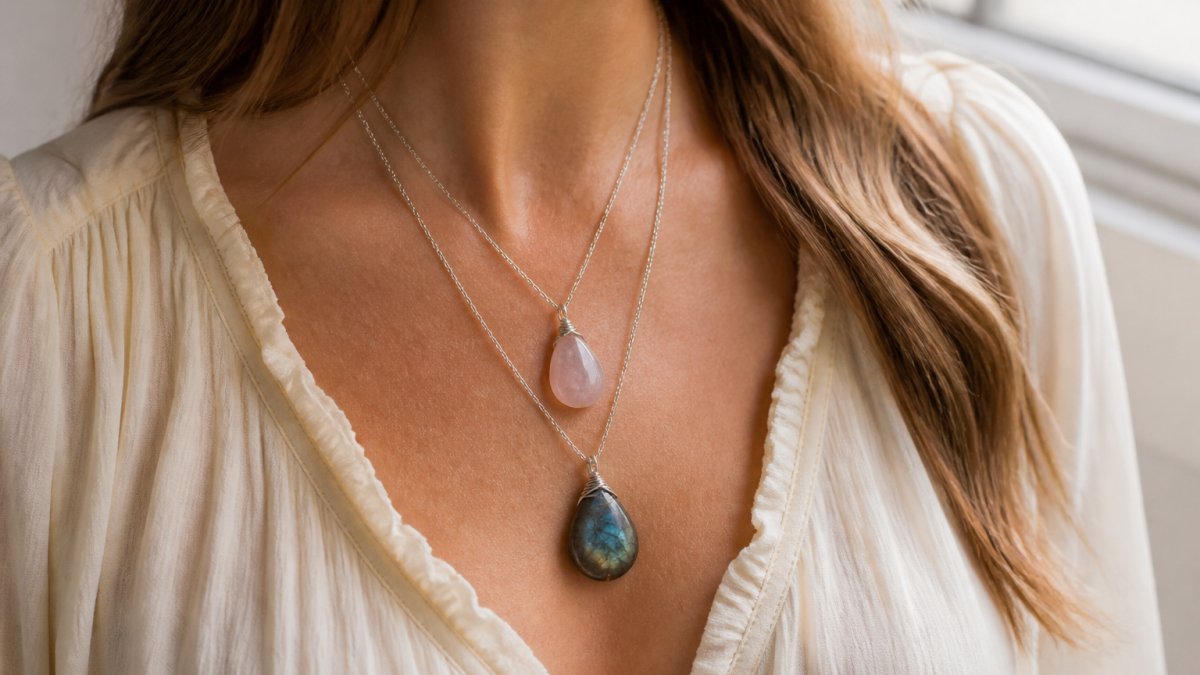
Our Labradorite and silver pendant necklace is the clearest example. At first glance the stone looks grey, but when light hits it, the colors shift and move.
The Rose Quartz Leaf pendant takes the opposite approach: a soft pink stone in a gold bezel on an 18-inch chain, with a leaf silhouette that nods to the outdoors without announcing it.
Elegant Gemstone Jewelry: Stones That Read as Sophisticated
Not every gemstone reads as elegant. Some are too bright, too large, or too busy for refined styling. The stones that work best in elegant gemstone jewelry share one quality: depth rather than flash, which comes from cut, clarity, treatment, and setting.
How to Judge a Stone Before You Buy
A gemstone's elegance is mostly decided by four things you can see in person or in a high-resolution photo:
- Cut and proportion. A well-cut stone returns light evenly across the face; a shallow or lopsided cut creates a dead spot or a window you can see straight through. In small elegant pieces, even light return matters more than carat weight.
- Clarity relative to the stone. Some stones are expected to be eye-clean, and some are not. A flawless aquamarine is plausible; a flawless emerald at a low price is a warning sign. Ask what clarity is normal for that species.
- Hardness and wear. The Mohs scale runs 1 to 10 (Natural Gemstones). Diamond is 10, quartz is 7, opal is 5.5 to 6.5, and pearl is 2.5 to 4.5. A stone below about 7 is better in earrings and pendants than in a ring you wear daily, because rings take the most impact.
Stones That Read as Elegant, and What to Check
- Emerald brings richness without glitter, especially in small, controlled doses. Emeralds are commonly treated, so ask about filling, and keep them out of ultrasonic cleaners.
- Labradorite shifts color as you move, which reads as sophisticated rather than loud. Labradorite is a feldspar in the 6 to 6.5 hardness range, so it suits pendants and earrings better than everyday rings.
- Freshwater pearl offers luster and texture and pairs with almost any metal. Pearls are soft and sensitive to perfume and hairspray, so they belong in the "put on last" category.
Setting Quality Is Half the Story
A beautiful stone in a weak setting looks cheap within a year. Check three things:
- Coverage. A bezel protects a soft stone; prongs show more of it but catch on clothing. For daily wear, a low bezel or a well-rounded prong setting is the safer choice.
- Seat and movement. The stone should not rock or spin in its setting. A stone that moves will eventually loosen or chip.
- Backing. Open backs let light through and are common in fine jewelry; closed backs can trap moisture against pearls and opals. Match the backing to the stone.
Our Freshwater Pearl & Emerald earrings show the principle at work. The green is earthy, the pearl finish is soft, and at one inch they flatter most face shapes. They also use stainless steel wires that resist tarnishing, making them ideal for sensitive skin.
If you want to compare stones across our pieces, our handcrafted gemstone earrings roundup groups them by stone type and wear occasion.
Delicate Layered Necklaces That Never Look Cluttered
Layering fails when every chain competes for attention. The fix is a clear hierarchy: one focal pendant, one mid-length chain, and one short or fine chain. Vary the length by at least two inches between layers, and keep metals consistent unless deliberately mixing them.
Peacock freshwater pearl coin wrapped in gold with purple goldstone beads →
Our Peridot Crystal wire-wrapped necklace is built for this. It runs 18 inches with a 1.5-inch extender, so you can adjust the drop to sit above or below a second chain.
Artisan Earrings for Everyday Wear
Artisan earrings for everyday wear need three things: low weight, secure findings, and a design that survives repetition.
Our Pink Pearl Gold Hoop Earrings hit that brief at $22. The 1-inch short dangle design offers subtle elegance suitable for daily use, and the gold-plated posts ensure durability and hypoallergenic wear.
For a full range of daily-wear options, our roundup of handcrafted gemstone earrings covers the styles that hold up best to constant use.
Caring for Handcrafted Jewelry So It Lasts
Handcrafted jewelry lasts when you store it dry, keep it away from perfume and chlorine, and check the findings every few months. Most failures are not material failures but storage and chemical exposure. The other half of ownership is knowing what each material can handle and what can be repaired.
A Simple Care Routine
- Put jewelry on last, after lotion and perfume have dried
- Wipe pearls and stones with a soft dry cloth after wearing
- Store each piece separately to prevent scratching
Use a lined jewelry box rather than a loose drawer.
Watch out: storing pearls in a sealed plastic bag traps moisture and dulls the luster over time. Use a fabric-lined compartment instead.
What Each Material Can Handle
Durability depends on the metal, the stone, and the construction together.
- Gold-plated and gold-filled. Gold plating is a thin layer over a base metal and wears through at high-friction points. Gold-filled carries a much thicker layer of gold bonded to the base and generally outlasts plating by years. Neither is solid gold; both need the same "last on, first off" habit.
- Sterling silver. Sterling is 92.5 percent silver and tarnishes when exposed to sulfur in the air. A polishing cloth restores shine; store silver in a tarnish-resistant pouch or a drawer with a tarnish strip.
- Stainless steel. Stainless steel is the most forgiving common jewelry metal. It resists tarnish and works well for sensitive skin, which is why we use stainless steel wires in several earrings.
Repair, Resizing, and When to Fix vs. Replace
Most artisan jewelry can be repaired, and repair is usually the better choice for a piece you love. Common fixes include:
- Re-soldering a broken jump ring or chain. A jeweler can usually restore a chain in a single visit.
- Replacing a clasp. Clasps are the first part to fail because they take the most handling. A new lobster clasp is a small, routine repair.
- Re-tipping or tightening prongs. If a stone feels loose, stop wearing the piece until a jeweler checks it. A tightened prong is inexpensive; a lost stone often is not.
Cost Per Wear: The Number That Matters
A $22 pair of earrings worn three times a week for a year costs about 14 cents per wear. A $200 pair worn once costs $200 per wear. Cost per wear is a better measure of value than the sticker price, and it is why a small, well-made piece you reach for daily often beats a dramatic piece you save for events.
To estimate it, divide the price by the number of times you expect to wear the piece in the first year. If the number feels high, either the piece is wrong for your routine or the price is wrong for the piece.
If you want pieces built for repeat wear, our handcrafted gemstone earrings roundup highlights the styles that hold up best to constant use.
Shop Handmade Pieces That Fit Your Style
The best artisan jewelry for elegant style is the piece you actually reach for.
Every piece we make is one of a kind, designed by Joilene and drawn from the outdoors. If you want something no one else is wearing, browse our one-of-a-kind handmade pieces and find the one that fits.
Frequently Asked Questions
What is considered artisan jewelry?
Artisan jewelry is made by hand in small batches rather than mass-produced in a factory. Each piece is shaped by a maker who selects the stones, sets them, and finishes the metal themselves. That means slight variations between pieces, which is part of the appeal. At Jasper Rain Designs, each design is created by designer Joilene and assembled by hand, so no two pieces match exactly. Look for details like wire wrapping, hand-set stones, and small runs when you want to confirm a piece is genuinely artisan.
How do I choose artisan jewelry that suits my personal style?
Start with the metals and stones you already reach for. If you wear gold tones, a gold-plated or vermeil piece will slot into your wardrobe faster than silver. If you prefer subtle looks, choose smaller stones and shorter drops; for a bolder finish, go for longer dangles and statement pendants. Try one new piece at a time and layer it with what you own. The best artisan jewelry for elegant style is the piece you actually wear, not the one that stays in the box.
How can I layer delicate necklaces without making an outfit look busy?
Use two or three chains of different lengths and keep the pendants small. A common approach is a 16-inch choker, an 18-inch pendant, and a 22-inch beaded piece, which creates separation instead of a tangle. Stick to one metal tone and repeat one stone family so the layers read as a set. The Labradorite and silver pendant necklace at 22 inches layers well over shorter chains, and the Peridot wire-wrapped necklace at 18 inches with a 1.5-inch extender sits neatly in the middle.
How do I care for handmade jewelry so stones and clasps last?
Put jewelry on last, after perfume and lotion, and take it off before showering, swimming, or cleaning. Wipe pearls and gemstones with a soft dry cloth rather than soaking them, and store each piece separately so chains do not scratch. Check clasps and wire wraps every few months for looseness. If a stone works free or a clasp fails, contact the maker before attempting a repair yourself.
Building an elegant jewelry collection takes patience and a good eye for proportion. Jasper Rain Designs makes that easier with handcrafted, one-of-a-kind pieces, natural gemstones, and designs built for daily wear as much as special occasions. Get started with Jasper Rain Designs and build a collection that reflects your own style.


